
It’s the new year, although we’re already into February, and like many others, I often start with good intentions, resolutions so to speak. We have in our hearts the desire to change for the better, to “drown our muskrats” as Henry David Thoreau says in the final chapter of Walden, though the task is certainly not an easy one.
My “muskrat” is not keeping things neat and tidy—essentially a lack of order.
For Benjamin Franklin, order was also a problem. Every year I teach an excerpt from Franklin’s Autobiography that discusses his attempt at moral perfection by instilling 13 virtues within himself. I won’t list all those virtues (though it’s interesting to see them) but Franklin tells us that the virtue of order vexed him the most, almost forcing him to give up on the whole project of self-improvement. This is certainly ironic, because Franklin, at least to me, seems like he’d have been the epitome of order, for he even lays out in the Autobiography a strategic and very ordered way that he plans to indoctrinate these virtues in himself. However, it wasn’t until this past year that I finally comprehended that it wasn’t so much an ordered mind that Franklin was wanting, but rather, I believe, an ordered space. Essentially, a home for everything and everything in its home. Apparently, Franklin had a great mind, but just like me, couldn’t keep things neat and tidy. And by no means, am I implying that I have a great mind.
When I tackled teaching Benjamin Franklin’s Autobiography this year, I wanted to bring in another all-star in organization, Marie Kondo, whose book The Life-Changing Magic of Tidying Up has probably drowned many a muskrat. Certainly, she knows that order can be transformative. For me, her method of folding clothing really changed my approach to the task. I wanted to share this with my students, so one day I brought several shirts to school and a box to serve as my drawer. I showed them how to fold their t-shirts in neat little packages that would be placed in a vertical fashion in the drawer. I enjoyed the lesson, but realized later, that I should have made it more hands on, so next time, everyone needs to bring a shirt.
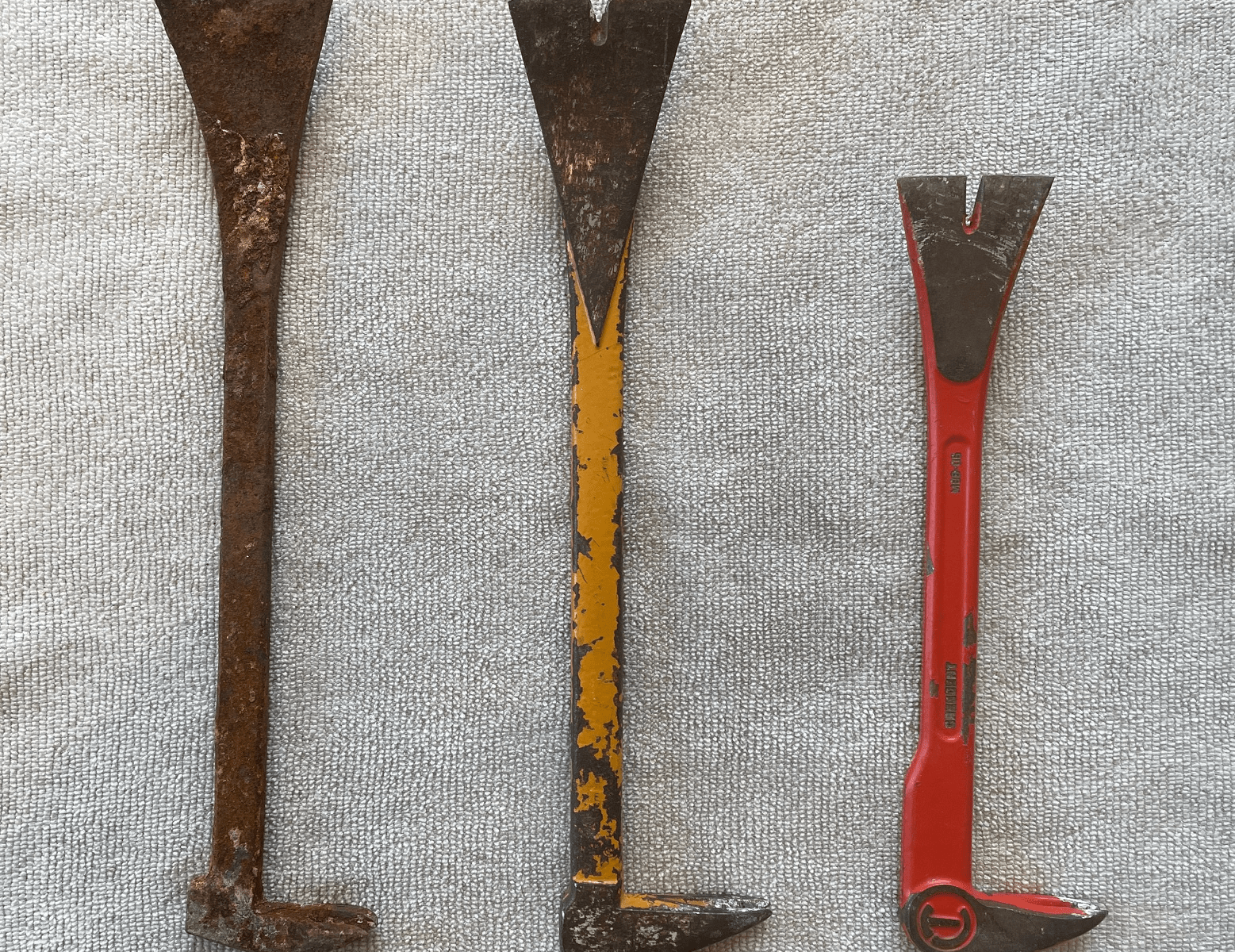
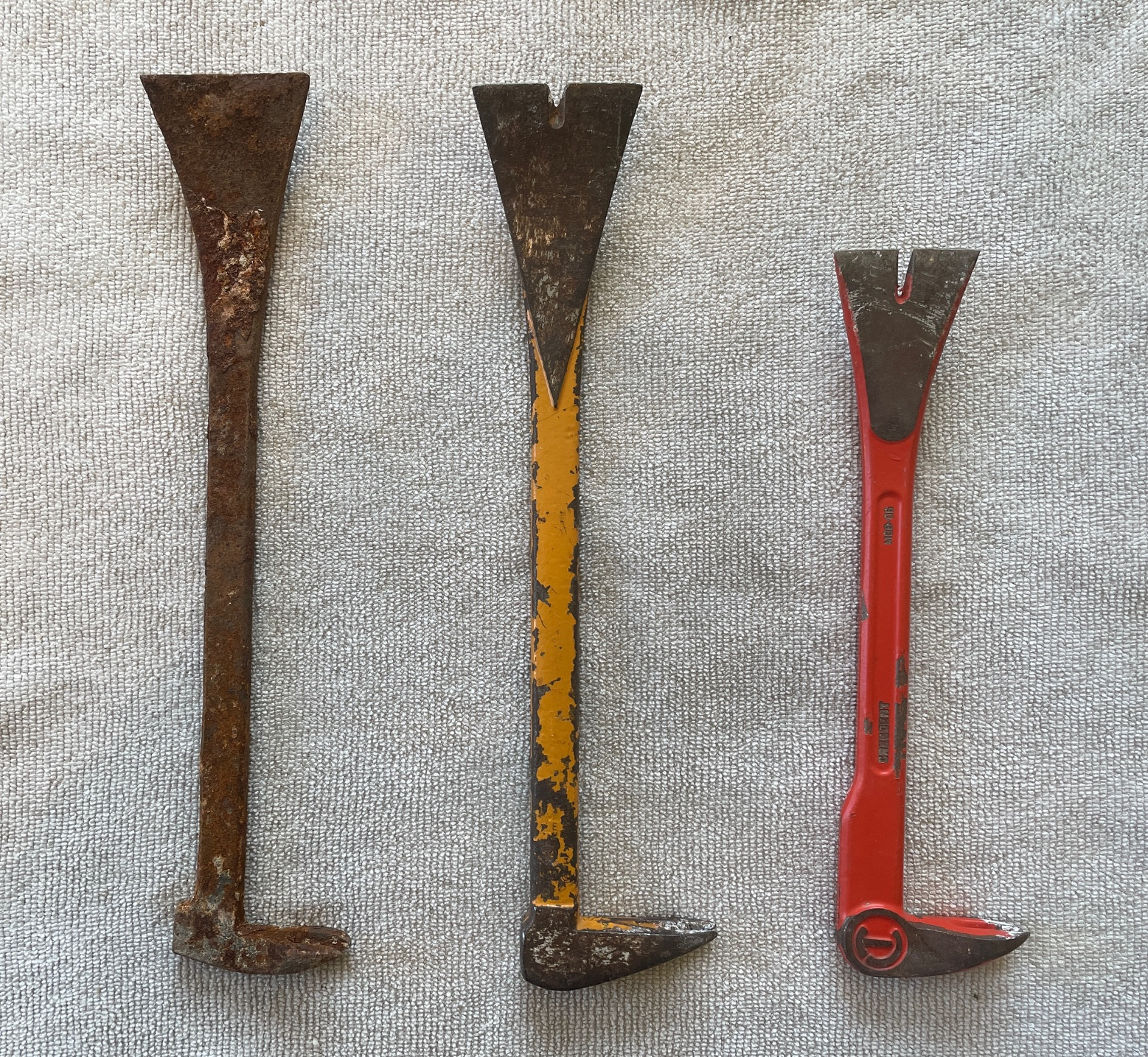
Of course, nothing punctuates book learning more than real life examples. In my world, I lose tools all the time because of my lack of order. As I live in an old house that seems to need almost constant repairs, I’m always tinkering with something and leaving tools in the wake of my projects. I found a hammer under my bed the other day, for instance. At the time when I was teaching Franklin this past year, I lost my cat’s paw, which is basically a small metal bar used for pulling nails with an end that resembles a cat’s paw. I must pull a lot of nails because it’s one of my favorite tools.
So I’m searching for my lost cat’s paw for days, before I finally break down and purchase one. That’s just about the time, I’m gifted one, too, so all is good. Now I have two. As luck would have it, though, I’m emptying the ash from my burn pile a few weeks later when my shovel hits something hard. What do I find? The missing cat’s paw. I must have thrown it in the wheelbarrow with the scraps and carted it off to be burned. So now I have three nail pullers—not because I’m just an aficionado of the tool, but because of my lack of order, and all this, of course, only further emphasizes my need to keep my tools organized better. Afterall, now I have three cat’s paws to keep organized.
For those on the quest for the one ring to control them all, another mindset might bring more order to your life. It’s called the 5S Method, and like Marie Kondo, it’s also Japanese. So the method represents five Japanese words at are used to create better workspace organization and efficiency. According to Wikipedia, these words are usually translated as sort, set in order, shine, standardize, and sustain. Now, I’m not going to claim to be an expert, in fact, as you’ve probably realized, I’m very much the opposite, but I like the 5S method, and I tried it recently with my little hobby of working on guitars and building effects pedals, also something where I claim no expertise. Basically, I had boxes filled with wire, switches, solder, resistors, capacitors, leds—all kinds of little bits and pieces, and truly a nightmare as soon as I might attempt to play Frankenstein and actually build some kind of noisemaking guitar gadget. Perhaps, I would have loved Frankenstein more if Victor suffered delay after delay because of misplaced tools. Like I’ve said, that truly drives a man to madness.
Hoping to avoid that self-made frustration, I sat down and sorted my parts, set them in order, and even shined them. I bought some storage for them, put labels on baggies and boxes, and arranged my work desk in a neat, pleasing way. Next, however, are the hardest parts of the method, at least for me. I haven’t standardized, which means to create the “rules” which will ensure my space remains organized. And, of course, sustain means to continue the practices put in place, which besides keeping everything neat, ultimately, results in an efficient workplace. Only time will tell if I can tame the monster.
For now, however, there still seems a lack of commitment on my part to get things in their places. Maybe I need a cat’s paw nearby. Maybe as an art piece. Hang it in a prominent place. Maybe as a reminder. Because as I sit here typing, I’m surrounded by a half dozen items on my desk that need to be put away. And there’s another half dozen on the workspace to my left. Not to mention the laundry that I folded but threw on the floor last night before going to bed. Clearly, there’s more work to do.
 The White Whale