
For the past few years, I’ve been collecting records, especially those albums that meant so much to me as a young boy growing up in the 1980s. Back then, some of my favorites were Men at Work’s Business as Usual, Def Leppard’s Pyromania, AC/DC’s For Those About to Rock, and ZZ Top’s Eliminator to name just a few titles that I wanted on vinyl. I even made some YouTube videos that highlighted my progress. Overall, though, I’ve kept my collection small, realizing that money and space and interest are all limited, especially when I can stream absolutely anything from my subscription services.
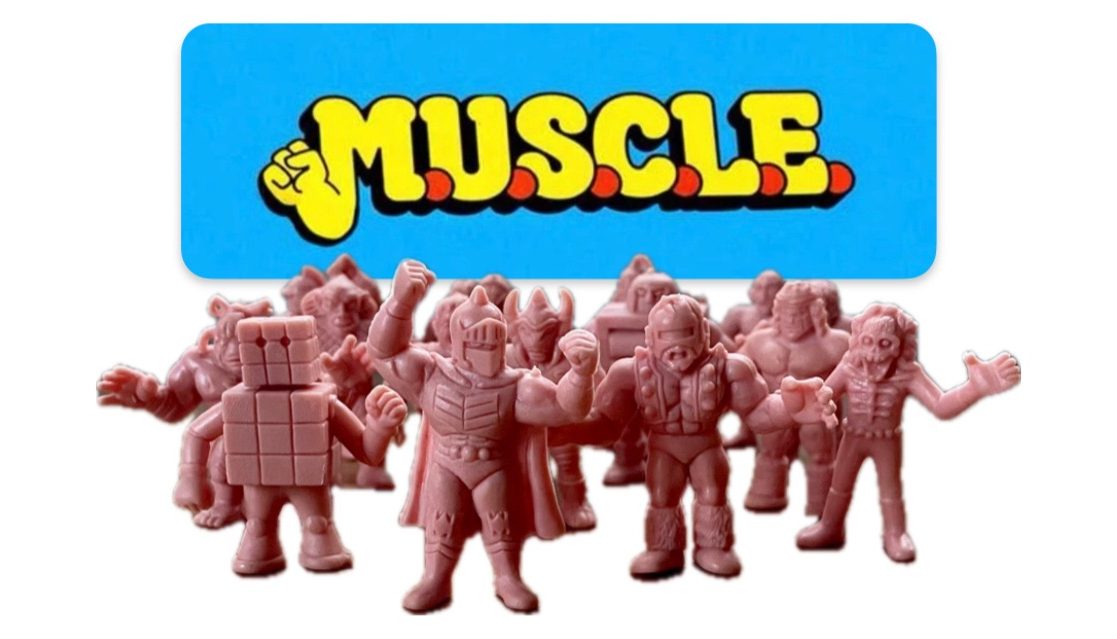
Now there’s something else that has me in collecting mode. Those little figures that debuted in 1985 under the name MUSCLE, an acronym for Millions of Unusual Small Creatures Lurking Everywhere. Among my GI Joes, Star Wars, and Transformers, my MUSCLEs hold a special place as they were the only toy from my childhood that I made sure to hold onto as an adult. Indeed, these figures really cast a spell on my friends and I during that debut year, which probably had to do with Mattel’s marketing and low price point. It’s hard to believe, but they sold in 4-packs for only a dollar. They also came in 10-pack trash cans for $4, a little reminiscent of Garbage Pail Kids, which also came out in 1985, and for $7, there were grandiose 28-packs with specific figures that were grouped together under names such as Cosmic Crunchers and Thug Busters.
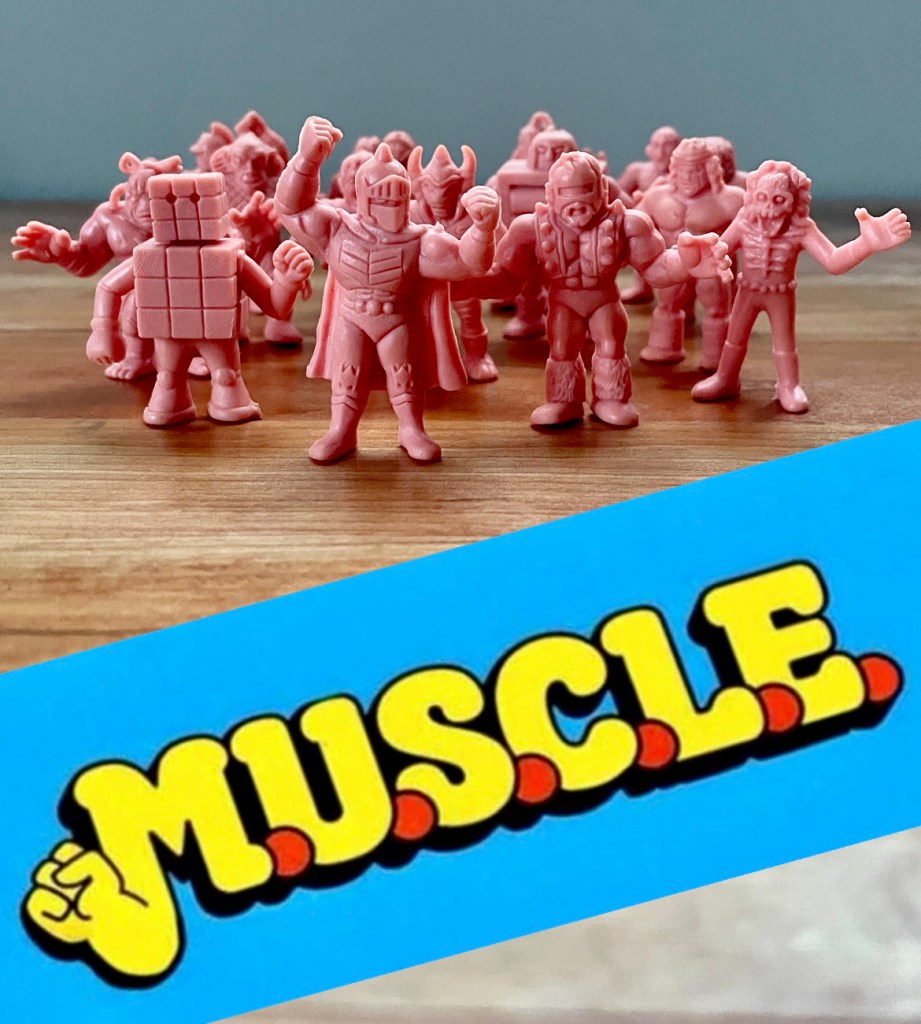
These price points made collecting MUSCLE figures quite accessible to young boys at the time, who could spend just a few dollars to create a decent collection. There seemed to be no end to them, but Mattel eventually released a mail-order poster with 233 different figures. I remember taping the poster to my bedroom door, thinking that I could finally track the progress of my collection. Certainly, this poster encouraged more sales, too, with one of Mattel’s commercials exhorting, “How many can you capture?”
Now it should be noted that many people consider the 1980s to be the golden age of action figures, with Kenner’s Star Wars figures leading the way for others. With regard to MUSCLE, the rise of professional wrestling in the United States, and specifically the World Wrestling Federation probably helped sales too. In 1984, the toy manufacturer LJN released Wrestling Superstars, large 8-inch figures of several prominent wrestlers at the time like Hulk Hogan, Andre the Giant, and Rowdy Roddy Piper. Although I never collected these figures, I was enamored with my best friend’s collection. The figures were large and chunky, over-the-top compared to Star Wars figures. And whereas my play with Darth Vader and Luke Skywalker focused on the figures themselves, my friends and I often play-acted the world of WWF, most notably, when swimming in my family’s above ground pool, which our imaginations easily transformed into a wrestling ring where we could jump from the ropes, hailing Jimmy “Superfly” Snuka with a splash into the water. No doubt, there were plenty of other adolescents playing out their wrestling dreams, which probably lead to LJN’s success with this product line.
The MUSCLE product line, by contrast, represented almost the opposite of Wrestling Superstars. To begin, these figures were very small, only about 2 inches tall. That characteristic alone made them appealing because I could bring them to school, which my friends and I often did once we started buying them. Never would I have imagined taking an 8-inch figure to school. They were just too bulky, but I could easily stick a handful of MUSCLES in my pocket or even more in my backpack. In addition to size, the quantity of figures, as I discussed earlier, made them ideal for collecting. Whereas there were only a few Wrestling Superstars, the great mountain of MUSCLEs made play, especially at school, much more interesting, because we might all have different figures with us, and moreover, we had to make selections because we couldn’t bring them all. To me, this all just increased the playability of the figures.
One factor, however, that made MUSCLEs different from WWF Wrestling Superstars as well as other toylines such as GI Joe and Transformers was the lack of television presence. Indeed, the MUSCLEs didn’t even have names except for the first two on the poster, Muscleman and Terri-Bull. It’s surprising that Mattel even greenlighted MUSCLEs without a morning cartoon to sell the figures, but I’d argue that this conspicuous absence became a strength rather than a weakness, allowing my friends and I to make our own storylines. We chose favorites, we created names, and we fought matches, building our own rings with nails and rubber bands.
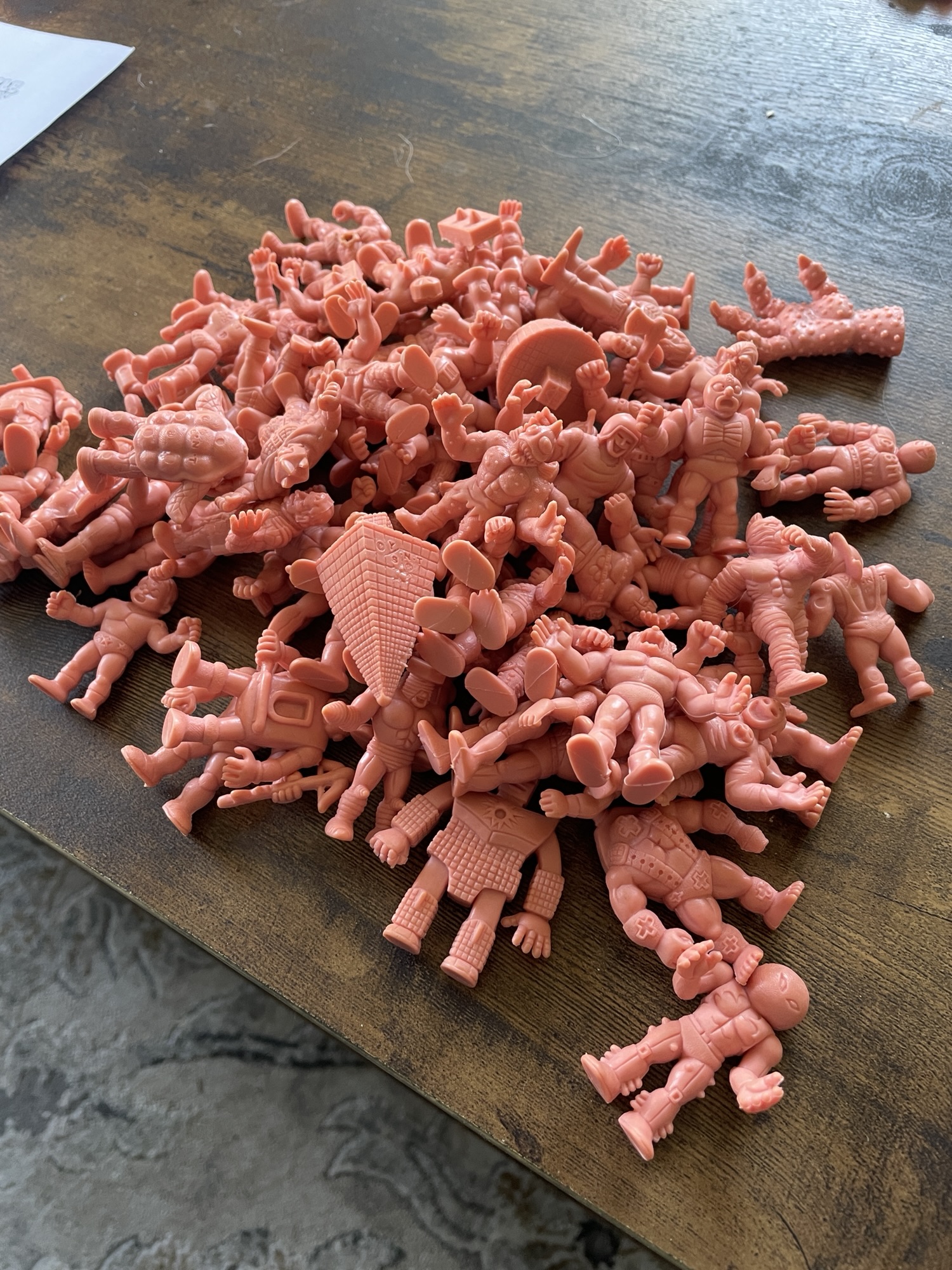
Our MUSCLE figures weren’t just a random collection, however, but rather part of a Japanese manga series called Kinnikuman, which ran from 1979 to 1987 in Japan’s premiere manga magazine, Weekly Shōnen Jump. By 1983, the storyline of good and bad battling for the fate of the world in the wrestling ring had spawned not only an anime, but over 400 eraser-styled figures called kinkeshi, a contraction of the words kinnikuman (muscle man) and keshigomu (eraser rubber). They enjoyed great popularity in Japan.
Of course, my friends and I were in the dark about any of this information in 1985 when Mattel started marketing MUSCLEs in the United States. They were just cool eraser-colored figures, eventually deemed the “flesh” color, though obviously there’s inherent problems in calling a color flesh. Eventually, Mattel would produce the same figures in a variety of colors, too. And while there isn’t much consensus in the collecting community about why Mattel only chose to release a little over half the figures, most people consider Mattel’s choice of harder plastic to be superior to their softer Japanese counterparts. For me and many others, this durable plastic has a distinctive quality that makes them, at least in my mind, more than just a cheap throwaway.
As to my collection, I began with 167 figures from the available 236. Not bad, and surprisingly, I didn’t have any duplicates. Maybe I made trades as a kid for the figures I still didn’t have, but I really don’t remember those details. Forty years later, through eBay and Facebook, I’ve added over 200 figures to my collection, including 50 new figures. My kids think it’s funny, even criticize me for my newfound obsession, but holding a MUSCLE brings me joy. It probably won’t last forever, but for now, I don’t mind taking some time to chase those last few figures, though they seem to get more and more elusive, to complete my collection. Maybe one day I’ll catch them all.
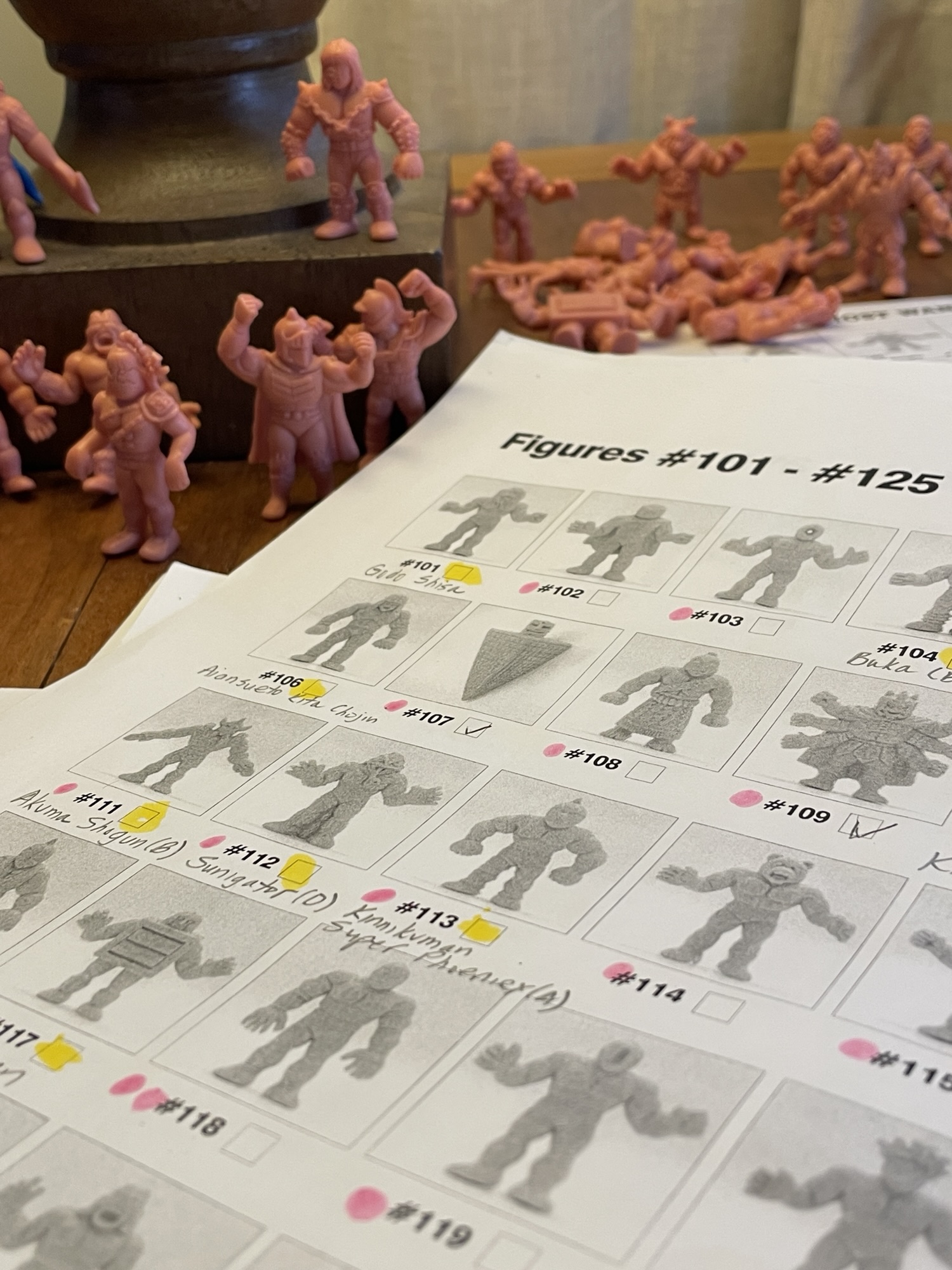
As to the mail order poster mentioned above, I had hoped to find the original poster from my childhood. Like many things, however, I’m sad to report that the poster seems to have disappeared with the passing of time. As a consolation, I’ve provided a link to a Muscle Checklist that I found buried in my computer files. It’s credited to musclefigures.com, a now obsolete website. When my son and daughter were children, they helped me catalog my figures, marking the missing figures on my list with yellow highlighter. Then I packed everything away again until a couple months ago. That simple list, today, remains my master checklist as I try to build my first complete collection.
Please consider subscribing to The White Whale to show your support and to receive notifications of the latest posts.
 The White Whale