
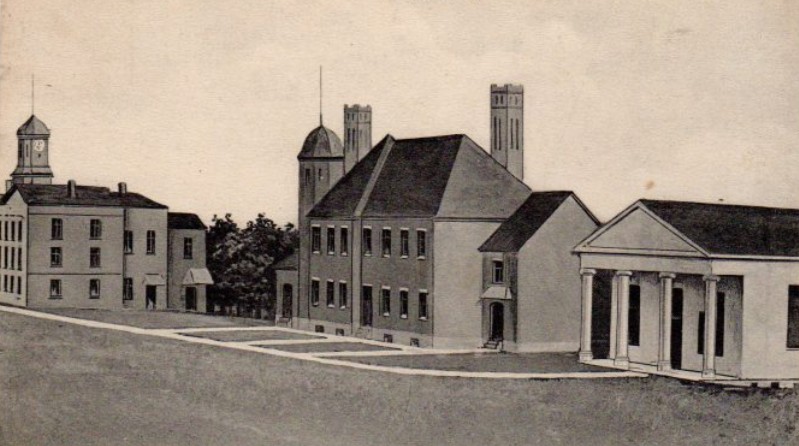
Here’s another piece in my continuing series about the original Susquehanna County courthouse in Montrose, Pennsylvania, built in 1813. Our old buildings, although we often have sentimental feelings for them, are often relegated to the dust bins of history. As we have seen with the recent demolition of the old Montrose hospital, we wake up one day and those buildings that have become like old friends are suddenly gone. For the old courthouse, this happened in late 1888 as Montrose cleared way for a new high school building. The courthouse had already escaped destruction in the 1850s by being moved to a new location before the construction of the second courthouse, but, unfortunately, it couldn’t withstand the march of time into the next century. The article below, which I transcribed from The Montrose Democrat, pays homage to the old courthouse with language both eloquent and grandiose. The anonymous author’s words provide a window into the past and a fitting epitaph for one of the county’s seminal buildings.
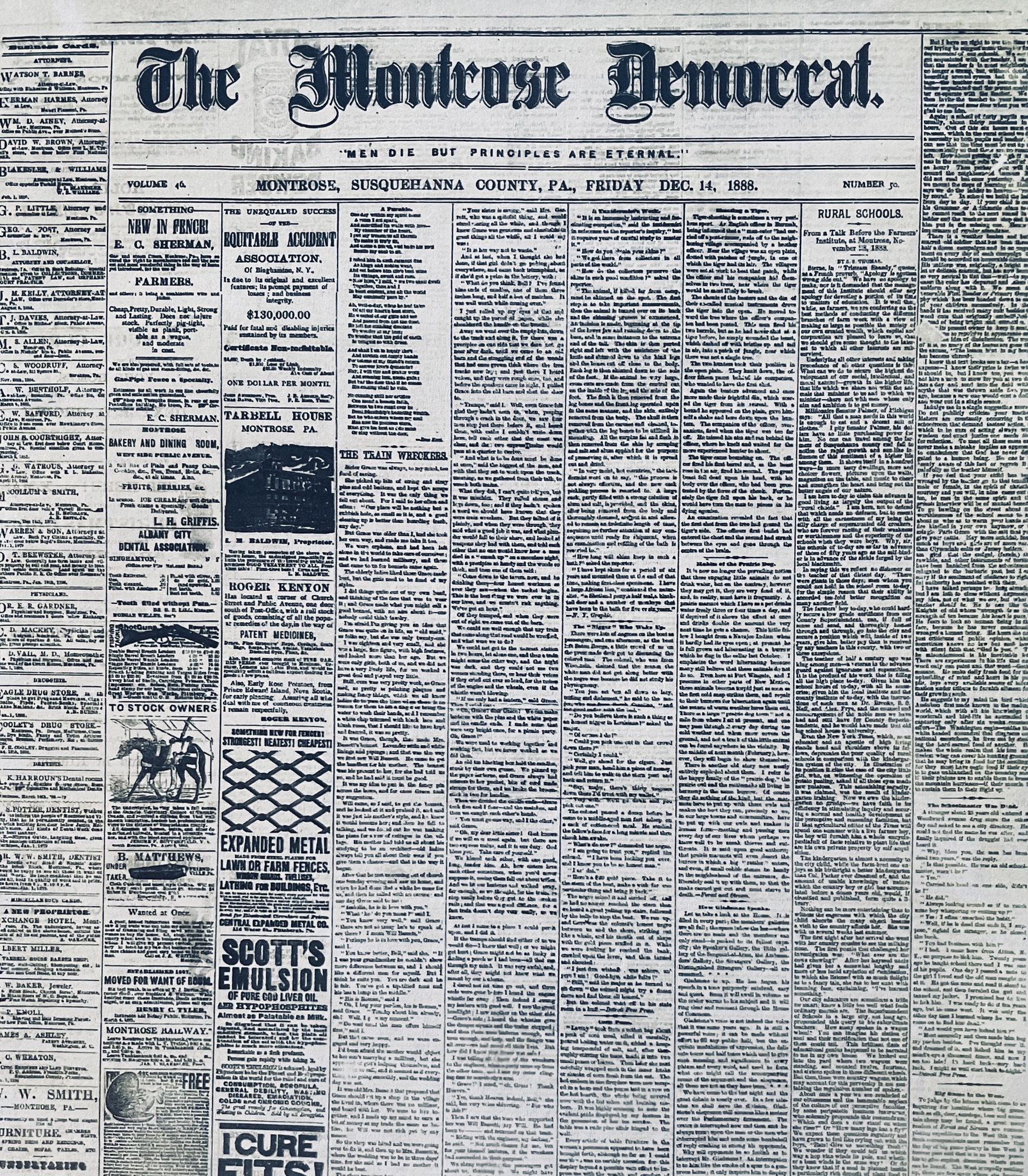
A LANDMARK DEMOLISHED
from The Montrose Democrat, December 14, 1888
Tearing down of the old court house—a building around which cluster many memories of the olden days
The gnawing tooth of time has done its work with the old Court House. For a mere pittance its old timbers have been sold, and the work of demolition is in progress, and soon it will be blotted out from the gaze of men forever. This is not an age of sentimentality, and doubtless many there be who witness the razing of Susquehanna County’s first Temple of Justice, with no other thought than that a dilapidated, unsightly pile is being removed, which shall result in improving the appearance of the town. But let it not thus unnoticed pass away! In its day it was considered grand, spacious and ornamental. It was reared by sturdy pioneers of the country who did so much for the development of its resources and whose names command honorable mention in Susquehanna’s history.
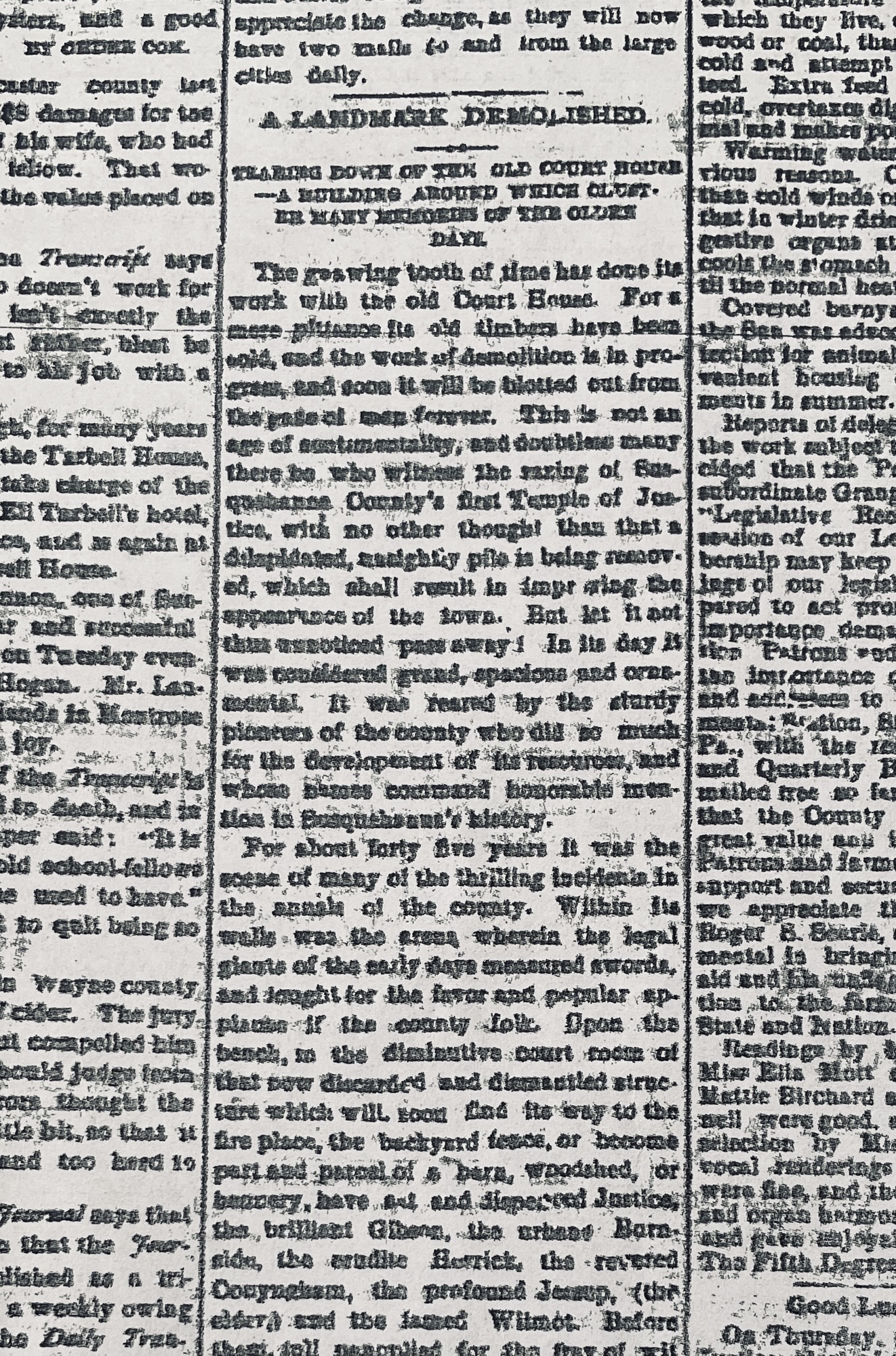
For about forty five years it was the scene of many of the thrilling incidents in the annals of the county. Within its walls was the arena wherein the legal giants of the early days measured swords, and fought for the favor and popular applause of the county folk. Upon the bench, in the diminutive court room of that now discarded and dismantled structure which will soon find its way to the fire place, the backyard fence, or become part and parcel of a barn, woodshed, or hennery, have sat and dispersed Justice, the brilliant Gibson, the urbane Burnside, the erudite Herrick, the revered Conyngham, the profound Jessup (the elderly), and the famed Wilmot. Before them, full panoplied for the day of wit and learning, in high contention battled men who carved their names high up on the scroll of fame in the realm of law and politics, and who have long since mouldered to dust. Among those were Geo. W. Woodward, Hendrick B. Wright, Horace Williston, the first of whom had a lustrous career as Chief Justice and as national legislator, the second became a politician of wide-spread note, and the latter for many years an upright Judicial officer in an adjoining district; and of resident lawyers conspicuous for their achievements were A. H. Read, Franklin Lusk, Davis Dimock Jr., Ralph B. Little, Joseph Richards, W. J. Turrell, B. S. Bentley, F. B. Streeter, L. F. Fitch, and E. B. Chase. The only lawyer now in active practice in the county who was admitted to practice at the old Court House is Hon. W. H. Jessup who came to the bar in November 1851.
It was in the old Court House that Jason Treadwell, the murderer, confronted a jury, and heard from the lips of the foreman pronounced the fatal verdict, “Guilty of murder in the first degree,” away back in 1824, and it was from that building that he was lead forth on the day of Execution, Jan. 18, 1825, by Sheriff Samuel Gregory, (Grandfather of Senator O. A. Lines) to meet his doom.
For nearly half a century political conventions met there, as they now do in the new Court House, and how many of the yeomanry of the county have there been crowned victors in the partisan strife and how many, many more have entered that building with bosoms swelling high with hope, only to emerge therefrom, vanquished, downcast, and humiliated.
It is old, decayed, and worthless now, but time was when to occupy a room in the old Court House, with the honors and emoluments of a county official, was the goal toward which there pressed an army of ambitious men. As we stand gazing at the work of destruction as with hammer, saw, bar, and sledge, the old Court House is giving way before the march of improvement of these latter days, we cannot but indulge in a reminiscent mood, and before our eyes pass in review the scenes of long ago, and the men who, when it was new, or in use as the county capitol, took prominent parts in the drama of our local stage. We see the crowds answering the clang of the bell, and in the jostling throng are the jurors, good and true, who have come from all the hamlets and districts of the county, to sit in judgment upon the disputes of their neighbors; we see the anxious litigants for spite or self, or in defense of their rights of person or property, are hanging on the ragged edge of suspense awaiting the result of their suit; we see the trembling culprit with blanched cheek, receiving a sentence which forever will put upon him the inescapable stamp of a convict; we hear the impassioned utterances of the legal lights of yore, as they sway jurors, and win professional spurs; we stand with the young barrister as he triumphantly gains the summit of admission to the bar; and his eye sweeps adown the vistas of glorious hopes and possibilities, and with him, we wonder “what of the future?”; we watch the procession of lucky men who have by the public voice been called to fill the county offices, as they joyfully entered upon their official life, and regretfully left it. All these sights pass before us as our eyes are turned toward the dead past, and as we are aroused from our reverie, by the crashing of falling timbers, or the noisome odor caused by the dislodgment of some rotten plank, we ask, “Where are they whom we have met as we have walked, mentally, the corridors of the mouldering past?” and the answer comes, “Gone, gone the way of all things earthly.”
And, so as departed the judges, lawyers, jurors, litigants, politicians, and officials who were wont to people the old court house in days gone by, so now must the racked old edifice itself go down, and like those who beneath its roof tasted the sweets of power, glory, and success, or the bitterness of defeat, disappointment, and failure, be lost to sight forever.
WHEN IT WAS BUILT
From Miss Blackman’s county history we glean the following facts regarding the building of the first Court House of the county: The corner stone was laid in 1812, but the building was not erected until 1813. Oliver C. Smith was the builder, and the cost was $4500. Isaac Post who as Treasurer of the county, circulated a subscription for building costs and the following donations were made: Robert H. Rose, $200; Stephen Wilson, $100; Abinoam Hinds, Conrad Hinds, and Isaac Peckins, $50 each; David Harris, Jonathan Wheaton, and James Trane, $25 each; Simeon Tyler, Cyrus Messenger, Samuel Quick, Joseph Hubbard, and Samuel Coggswell, $20 each; Joseph Chapman, Edward Fuller, Jos. Butterfield, Henry Post, Levi Leonard, John Bard, Zebulon Deans, and Edmond Stone, $10 each; Freeman Fishback, Thos. Scott, and Samuel Scott, $5 each. It was occupied for court purposes until 1855, when the growth of the county rendered its cramped quarters inadequate and the present court house was built at an expense of $20,000.
Please support The White Whale by subscribing to future posts.
 The White Whale
Guess there are many interesting stories to be told from every courthouse across the country–I’ve read some excellent fictional novels that have incorporated tales that are quite fascinating and keep you turning those pages. Considering that can include a multitude of crimes from bank robberies, to murders, and more, every courthouse would make a perfect stepping stone to launch a novel from.
Seasons greetings, Bill
>
LikeLike