

As fans, we know that Jason Isbell’s lyrics can be a bit cryptic. “Cast Iron Skillet” comes to mind, for example. It’s comforting then to hear straightforward songs like “Tupelo” or “Something More than Free.” I love that simplicity. And sometimes there’s a song with a line or two that just needs clarification for a better understanding.
For me, this happened with “Maybe It’s Time,” the song Jason Isbell wrote for Bradley Cooper to sing in the movie A Star Is Born. I love this song, in part, for its simplicity. It’s a song I’ve kept in my repertoire for several years now; however, every time I sang this song I glossed over the line about the world being just “one big ol’ Catherine wheel” without much thought. From the context, I gathered that a “Catherine wheel” must be something bad, but I never, for whatever reason, went searching for a definition.

Then, a few years ago, I took an interest in collecting records. I began by tracking down the albums of my youth. I found copies of Men at Work’s Business as Usual and Cargo. Someone gifted me Pyromania by Def Leppard. Among others, I’m still looking for copies of Van Halen’s 1984 and AC/DC’s For Those About to Rock. But the album that mattered the most to me was Black Sabbath’s Greatest Hits from 1977. In the 80s, I had this album on a cassette from Columbia House, the mail order that included those little stamps and the boast of getting a dozen albums for the price of one. I played that cassette so many times, always intrigued by the album cover, maybe even more than the music. This was before the internet, so I knew nothing about the artwork. It seemed the epitome of the song “Black Sabbath” with its tritone, the musical sound that was banned by the Catholic church as being of the devil.
So that was the first album I bought on eBay. Sadly, the album, as I’ve learned now, wasn’t pressed well. The sound was a big disappointment. It even skipped. To make things worse, the album sleeve was made of flimsy cardboard and the glue was coming apart. On the plus side, though, I could finally see the artwork larger and more clearly than ever before. The painting is called The Triumph of Death by Pieter Bruegel, The Elder, a Dutch painter during the 1500s. And the album’s back sleeve contained more artwork that wasn’t on my Columbia House cassette, including some close-ups of the painting.
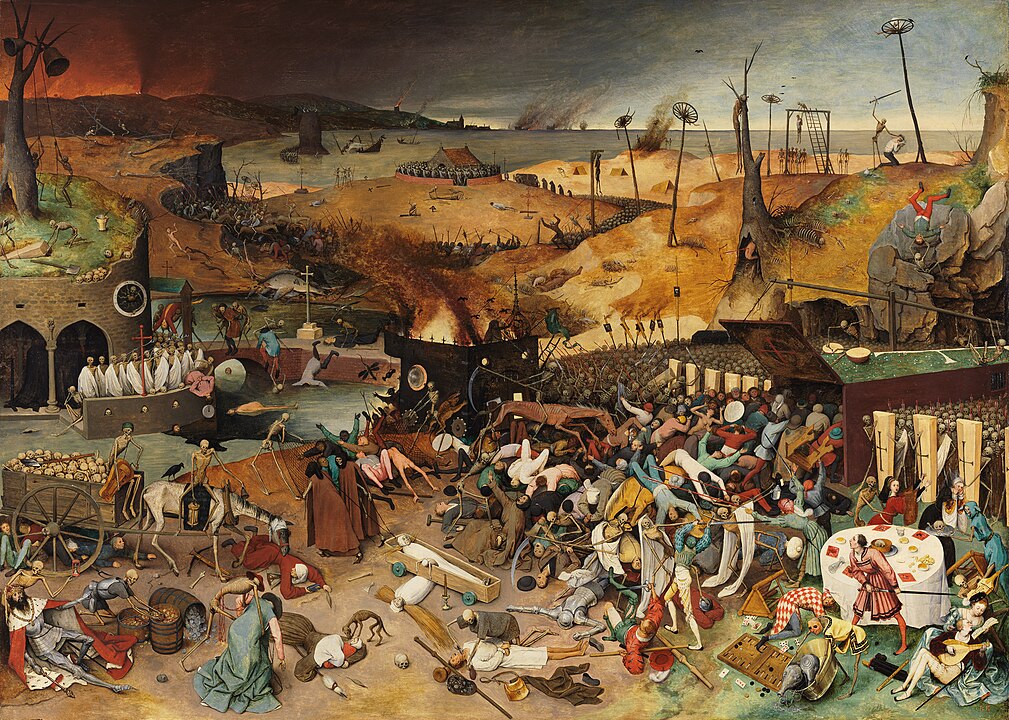
So where is Jason Isbell in all this? Well, for the first time, I saw something that seemed like an alien from H. G. Wells’s War of the Worlds. Fortunately, I could do an internet search, and these contraptions that looked like aliens to me actually had a name: a Catherine’s Wheel. As I read, I discovered that they were a terrible method of cruelty and death where a person’s legs were broken and weaved within the spokes of a wheel. If that’s not enough, the person and the wheel were then hoisted upward on a pole where one eventually came to a terrible end. Saint Catherine, apparently, was killed in such a manner, and afterward, the device became known as a Catherine’s Wheel.
I had stumbled over the meaning of my mystery lyrics in “Maybe It’s Time.” Here’s an excerpt: “I’ve seen hell in Reno / And this world’s one big ol’ Catherine Wheel spinning still.” To me, these are the most obscure lines in the song, and if you listen to the whole verse, there’s some interesting slant rhymes here, too.
For me, after making the comparison of the world to this ancient torture device, the lyrics suggest much more pain than I first understood when I heard this song. Some consider the breaking of legs, especially the femur, as one of the most painful fractures in the body, and, indeed, the victim of a Catherine’s Wheel suffered broken legs in order to be placed upon it. Besides pain, the comparison reveals a kind of betrayal, too, where the narrator has learned that the world is not his friend. Maybe you’ve heard the saying, the world is your oyster, which means the world is open to you and your dreams. For the narrator that dream, and its optimism, seems to be over. No oyster, but a Catherine’s wheel.
Isbell’s choice of this wheel also suggests a kind of spectacle. Public executions in any manner of ways were seen as deterrents throughout history. Think of scenes from movies where everyone gathers round the guillotine, or maybe a novel like The Scarlet Letter, where the main character must wear a letter A as punishment for her adultery. Saying that the world is a “big ol’ Catherine Wheel,” according to the narrator, probably comes with the sinister realization that people often enjoy watching someone fall apart. Indeed, there’s even profit in someone else’s misery as seen with the rise of tabloids. That’s a pretty bleak estimate of life.
It might be, too, that the repeated lines at the beginning and end of the song also have more significance with this new understanding. “Maybe it’s time to the let the old ways die.” This song is about change, and I can’t help thinking that the narrator is hoping to change the elements that make his life a Catherine’s Wheel, which include “old ways” of thinking. The Catherine’s Wheel might serve as a symbol of those old ways. It’s notable that he begins with the uncertainty of “maybe” rather than something stronger, perhaps, using this uncertainty as a way of initiating a very difficult conversation about the value of long-held customs and traditions. His suggestion that the old ways might “die” as opposed to killing them outright seems very passive, too, which might be less difficult for people to accept. To me, the song says, look, we can change. We can just let these harmful ways die. And somehow that might seem easier because it’s not a mass protest or revolution, but something simple and natural.
Of course, we know that change is difficult. We can applaud this broken narrator in the song for suggesting an alternative narrative, but history has taught us again and again it’s hard. Is the narrator naïve? Probably not. Instead, I think “Maybe It’s Time” is like the beginning of a long conversation, perhaps. He’s throwing out possibilities, underscored by the word “maybe,” which reminds us not only that we can change, but that there’s other possibilities to living in a world likened to a Catherine’s Wheel.
Please consider subscribing to The White Whale to show your support and receive notifications of new posts, usually about one each month.
 The White Whale
I would’ve thought that perhaps the ‘Catherine Wheel’ referred to the firework that spins and spins constantly showering out bright sparks as it burns away… perhaps a reference to the world burning all around us yet we continue along our path..
LikeLike
You make some incredible points regarding Isbell’s use of the phrase “And this world’s one big ol’ Catherine wheel” regarding the immense pain of even being placed on the torture device by having legs broken, and the public spectacle. The world does love watching individuals suffer, and it feels like the world revels in it. However, I feel like there may be another possible interpretation… The reason Saint Catherine underwent this torture was an attempt by Maxentius to force her to denounce her faith as he was persecuting Christians. Legend has it that at the start of her execution, before even being place on the wheel it broke, typically this would have been considered God’s intervention and the individual left alive. Maxentius however ordered her execution. Is it possible that this whole stanza then relates to the previous? Arguing that the world is losing its faith in “Nobody speaks to God these days / I’d like to think he’s looking down and laughing at our ways”? And that the world, being a Catherine’s wheel is here solely to make us lose our faith or at least make an attempt? But how does that fit in with the other stanzas? A man trying to change, nervous and scared to change, broken even but knowing today is better than back then? I feel the use of maybe solidifies this, It feels almost like the narrator is reaching out the listener, asking for our perspectives and possibly even our permission? The middle of the song is the narrator being forthright about his struggles and views, yet he isn’t confident enough to take that first step.
LikeLike