

Something unique happened to me at the end of this past academic year. I taught John Steinbeck’s Of Mice and Men at the same time I was teaching Jack London’s The Call of the Wild, two novels that seem wildly different at first glance. At some point, while my students and I made our way through these two books, I realized something significant: both novels have characters named Curly.
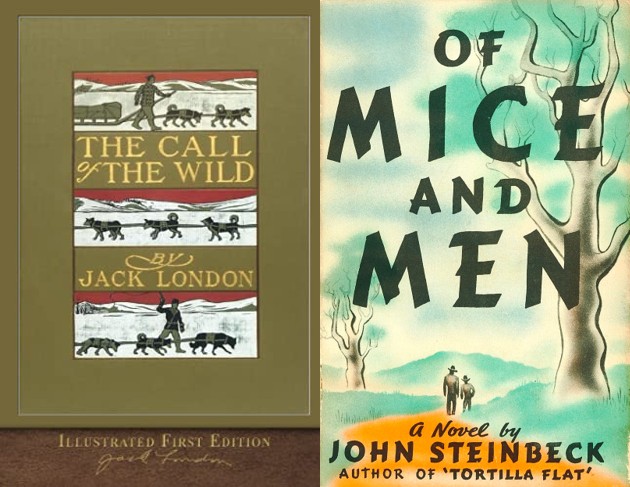
So perhaps this coincidence isn’t a big deal, but some things started to fall into place that made me reconsider what I say about these characters, especially Steinbeck’s Curley in Of Mice and Men, which includes an “e” in the spelling of the name. In the past, I often talked about name symbolism, discussing Curley as a pugnacious character, kind of wiry. He is a former boxer, tough and aggressive, but also small in stature. By contrast, Steinbeck describes another character in the novel, Slim, as specifically being tall, giving him a name that also emphasizes this trait and making him the obvious foil to Curley in terms of stature, both by his physical body and earned respect. I also tell my students to think of Curley as doing curls and exercises that might strengthen his ability to punch in the boxing ring, something that emphasizes his aggressive nature, which may be seen more as a weakness than a strength.
After many years of studying the book, however, I never understood that the name Curley has a connection to dogs. Maybe this surfaced for me because I was reading Jack London’s description of sled dogs in The Call of the Wild while teaching Steinbeck’s novel, but I was reminded that a “cur” refers to an aggressive dog—moreover, a dog that is a mongrel or in bad condition. In Of Mice and Men, where animals, especially dogs, have such important symbolism, it’s hard for me to understand how I may have missed this element. Steinbeck’s characterization of Lennie in the novel often paints him with animal-like descriptions, especially dog imagery. It’s not a stretch, therefore, to believe that Steinbeck may have chosen the name Curley to further enhance this imagery and symbolism. Curley is like a vicious dog, even rabid, picking fights with others on the farm.
In The Call of the Wild, Curly—spelled differently, like I said earlier—is a dog that only makes a short appearance. London may have chosen the name for its blatant connection to dogs, which is easier for me to recognize now. In a short scene from the novel, Curly becomes the victim of a pack of dogs when she makes the mistake of an unwanted advance toward another dog that swiftly attacks her and eventually leads to a large group of dogs killing her. It is a gruesome moment in the novel, where Curly’s name becomes synonymous with the cruelty of the dogs.
But this scene from The Call of the Wild also reminds me of Curley’s cruelty in Of Mice and Men, which now that I’ve connected them, seems burnished in my mind. In another fight scene, Curley attacks Lennie, much bigger than him though mentally challenged, as a means to repair his insecurity. This goes undeniably wrong when Lennie crushes Curley’s hand, which is damaged so badly that Curley is forced to tell the others that his hand was hurt in a machine to both protect his ego and Lennie’s employment on the farm. In both cases from these two novels, the “victim” named Curly is smaller and ends up losing, but our sympathy does not lie with Steinbeck’s character, because Curley deserves the violence that comes to him as retribution for his own cruel behavior.
My intention here is not an exhaustive study, but to explore some of the symbolism suggested by a common name. To me, it seems fair to make the connection between the definition of a “cur” as a dog and the name “Curly” because of the very prominence of dogs in both these novels. Undoubtedly, these two characters are tied to violence through a fight scene in each novel. Some of that violence may also be implied with the connotation of the word “cur,” which is something I wouldn’t have considered if I hadn’t encountered these novels at the same time.
The name Curly is tied to a size distinction, too, as I’ve pointed out. In both books, the characters who bear this name are smaller than their adversaries, showing a very clear physical inferiority. By using the name Curly, London and Steinbeck may be giving a nod to the inferiority suggested by the word “cur” to create more symbolism. Since social hierarchies play such important roles in each novel, the choice of a name that plays into those power structures may be an easily overlooked detail in both books.
 The White Whale
So interesting! I often think about how Curley’s wife, the only female character in Of Mice and Men, doesn’t even have a name – she’s just “Curley’s wife.” To me, this adds to the discomfort and even aggression of Curley as a character.
LikeLike