
By the time Montrose, Pennsylvania, was given its official name, Isaac Post had lived there for over ten years. As a teenager, he had taken an axe in hand to begin clearing land, and as the place attracted more and more people, Post constructed many of the early buildings, including the first painted house in Montrose. It was red.
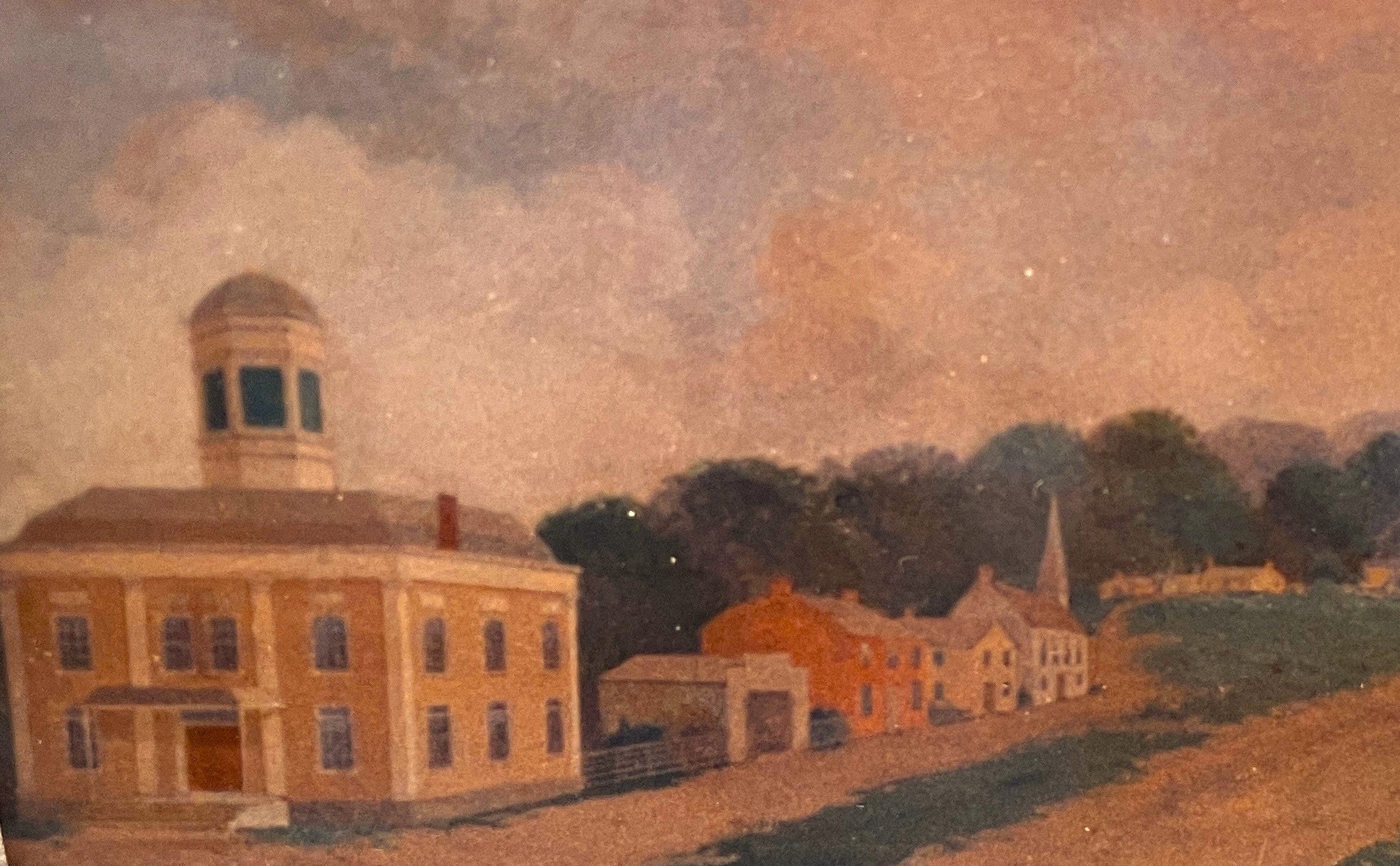
However, when Post left his house in the dark of October 7, 1813, he headed toward a building more important than one merely painted red. Newly built at a cost of $4500, a courthouse now occupied the top of Public Avenue on land set aside for public buildings in Montrose. In fact, Post donated much of the land for these buildings, and in some places, many stumps remained from the recently cleared trees. Eventually, this land at the heart of the burgeoning community became known as the Montrose Green, where other town buildings such as the academy and jail found a home.
Having helped lay the first cornerstone of the courthouse, Isaac Post had championed this new building. Early accounts of Montrose, especially those by Emily Blackman, who wrote The History of Susquehanna County, report that he “raised” many important buildings including a tavern, store, and post office. Serving as the first town treasurer, Post also collected donations to fund the building’s construction.

As he walked up Public Avenue toward the courthouse, he carried a small pumpkin. As the fall air grew crisp and cool, pumpkins probably filled the little patches about the town, destined for pies or jack-o-lanterns, but Post had a specific purpose in mind for this pumpkin.
Many public institutions like schools and courthouses and churches included something called a finial as part of their roof design. It is a decorative feature often in the shape of a ball, though they come in other shapes and figures as well, that’s placed upon the highest point of a building. Sometimes they appeared on lightning rods above a cupola, steeple, or gable. The practice, dating back hundreds of years, has said to bring good luck and symbolize eminence.
Post certainly saw the new courthouse as a building of great distinction, something often attributed to places of government and law. He even called it a “Temple of Truth.” Over the coming years, the building served not only as a seat of justice, but also a meetinghouse for sermons, funerals, and campaign speeches. For Post, all the details needed to measure up with his expectations for a proper courthouse, right down to the finial at the top of the roof. The building still didn’t have one, so, as was his nature, he found a solution.
With the pumpkin in hand, Post opened the door to the courthouse and mounted a staircase to the second floor, the location of newly installed courtroom for the county. Once there he might have climbed up through the octagon-shaped cupola, each side with a shuttered opening, to gain access to the roof. Then again, he may have found another way to the roof, perhaps using a ladder left at the site for construction.
Unfortunately, the historical record isn’t clear about Isaac Post’s particular actions up on the roof. There are two places, for instance, that Post might have wanted to place a finial. One likely place would have been the top of the cupola, and in a photograph from 1865, we can actually see the domed cupola with a ball at the top. This seems very dangerous to climb, though, and the ornamentation on the cupola probably came about later.
The roof above the entrance might also serve as a likely place for a finial, especially if there’s a peak. Often, the architecture of important buildings had a triangle-shaped gable end, called a pediment, that rested above columns like some of the buildings of ancient Rome and Greece. During the 1800s, government and religious structures often copied this style. In Montrose, the Universalist Church built in 1843 and later the second courthouse completed in 1855 featured this architectural design.
However, though the courthouse included columns, it did not have a pediment but rather a front façade that extended above the roofline, creating a low wall along the edge of the roof called a parapet. Looking up, the center of that parapet high above the entrance and facing Public Avenue, seems the perfect spot. Here, Post might have delicately placed his pumpkin, just far enough that onlookers might admire the stately golden finial that now adorned the new courthouse without ever guessing at the truth.
The pumpkin may have only lasted a season at the top of the courthouse, but Post appeared to have pleased himself with the mischief. In his diary, where he recorded these early days of Montrose, he wrote: “Took a very fine yellow pumpkin & put it on the Courthouse for a ball and it passed well for a gilt one & none could discern to the contrary.” The short entry leaves much to the imagination, but Post clearly felt the thrill of success on that fall day in October. Did others look up and admire the golden finial? Did they know about the secret pumpkin hidden in his diary? These questions will never have answers, but Isaac Post proved himself, like so many other times, always willing to go the extra mile for the place that he called home.
Bibliography
Blackman, Emily C. History of Susquehanna County Pennsylvania. 1873. Regional Publishing Company, 1970.
Post, Isaac. Unpublished Diary. 1814. Diary.
Quackenbush, Jan. Montrose Through the Years. The Montrose Recreation Committee, 1976.
Stocker, Rhamanthus M. Centennial History of Susquehanna County Pennsylvania. 1887. Heart of the Lakes Publishing, 2002.
Susquehanna County Historical Society. Images of America: Susquehanna County. Arcadia Publishing, 2010.
 The White Whale
What a charming story! Sometimes, we wonder if family lore is truth, fiction, or colorful, creative embellishment. As generations of Isaac Post’s have come and gone, we lose many stories to time. Diaries, at least, leave us glimpses of lives lived. Such stories give us connections to our lineage. In 1919, my paternal grandmother, Margaret B. Post Pitts, naming her second son Isaac Post Pitts, restored the name to the line. In 2018, Isaac Post Pitts, IV, was born and continues the line into this new millennium. A fine secretary desk of this Isaac Post, referenced in his papers, travels with this line. It is decorated with ornate inlays of various woods and a Masonic emblem. Inside the craftsmanship of fit and finish is meticulous, including several unique hiding places. In my life, I recall many mentions of the Isaac Posts but the details have already begun to fade. One item of note is a revolutionary war uniform that has been held or displayed in a local museum in Montrose, from my grandmother mentioned earlier. I would be very interested in visiting to see what more you might have on my family that could be of interest to future generations of this line. Thank you again for sharing the story. Most Sincerely, Isaac Post Pitts, Jr.Camden, SC
Sent from AT&T Yahoo Mail on Android
LikeLike
I love this writing! It pieces together historical facts into a writing that heightens one’s curiosity of the Courthouse and of the man, Isaac Post. The community of Montrose owes much gratitude to this man who looked to the future. The research you did is so interesting, even the diary entry “Took a very fine yellow pumpkin….” I will see the Courthouse differently, as I imagine how it was first built on land of “recently cleared trees”. Thank you for sharing this.
LikeLike