
As I began my last writing project about Isaac Post, I started digging into the history of the original courthouse in Montrose, Pennsylvania. It’s always interesting when I come to a project with preconceptions that get suddenly blown away by the facts. I knew, for instance, that the courthouse was built in the summer of 1813, the cornerstone having been laid in 1812 by Isaac Post, who served as county treasurer and solicited donations for the building’s construction. At a cost of $4500 dollars, Oliver C. Smith built the structure, which included a courtroom on the second floor with county offices and a jail located on the first floor. The place must have bustled with more and more activity as people settled in Montrose.
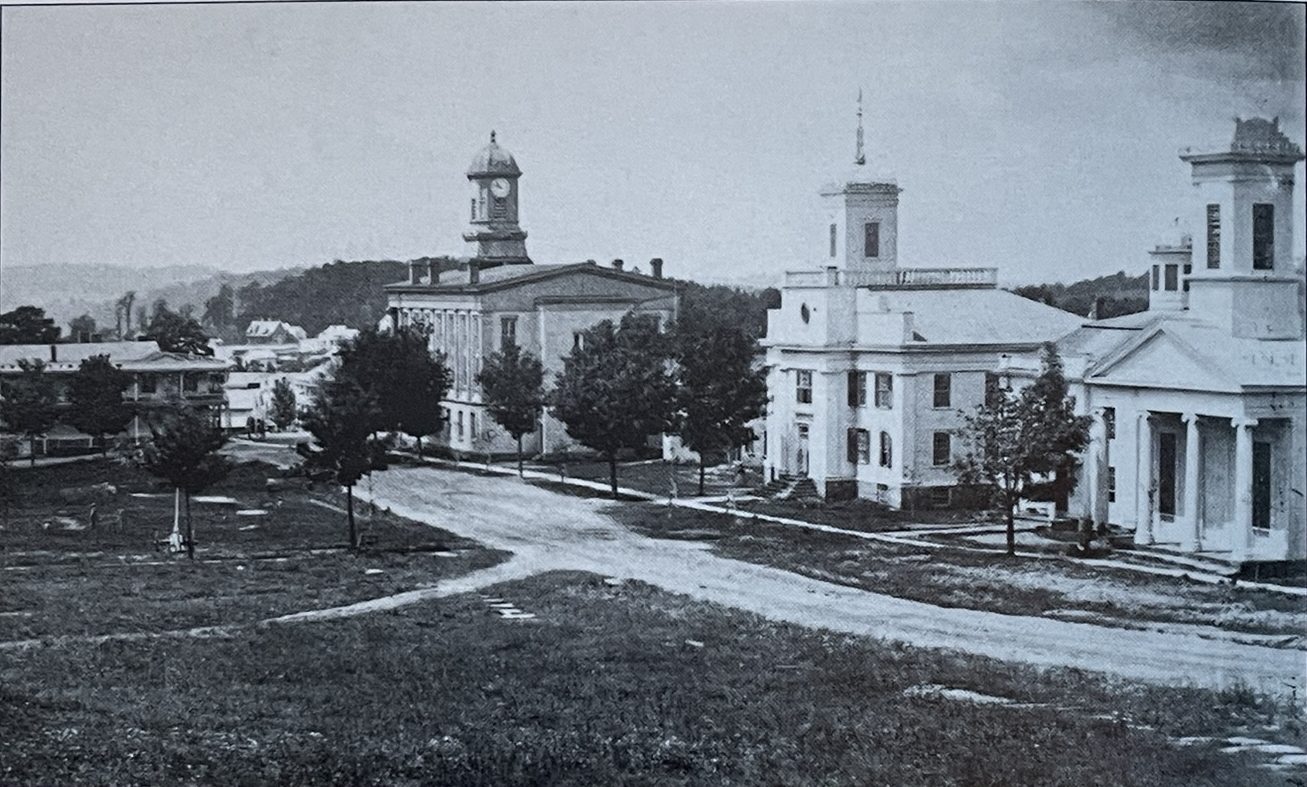
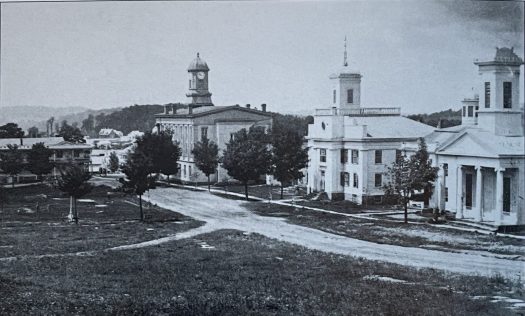
What’s interesting, and really goaded me in my research, was the fact that I couldn’t find any good photographs of the building, which was ultimately, torn down in 1888—more about that later. The only photograph of the courthouse I’d seen can be found in the Images of America: Susquehanna County book, which shows the new courthouse completed in 1855 as well as Montrose Academy and Unitarian Universalist Church. The original courthouse is between them, barely visible except for the roof, parapet, and cupola. A calendar produced by the Susquehanna County Historical Society dates the photo to about 1865, and I keep hoping that other photos are out there with a picture of the building, perhaps tucked away in someone’s old family albums.
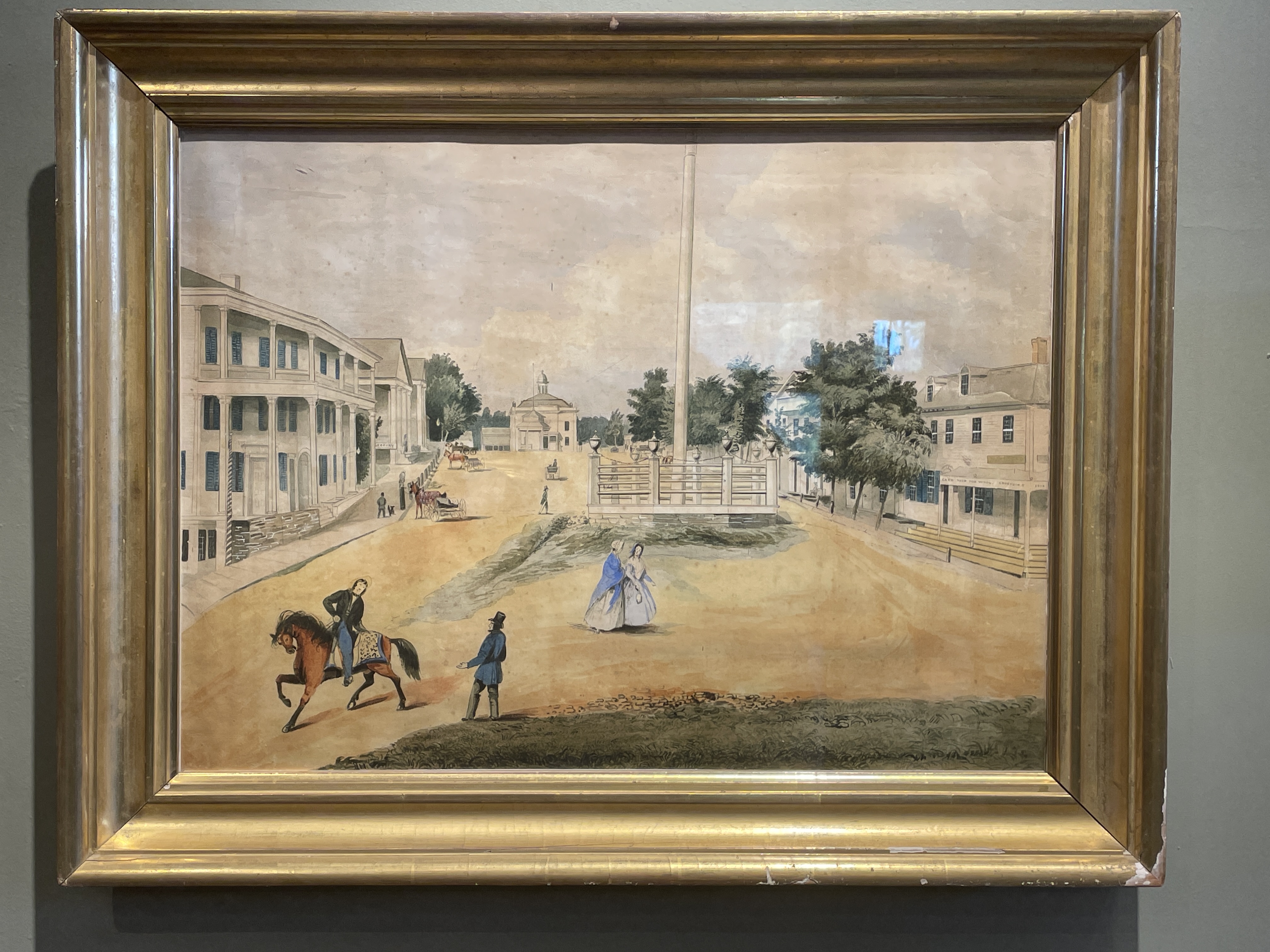
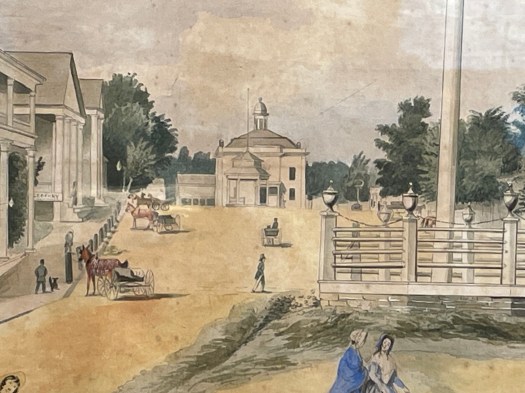
I did find, however, at least three artist renderings of the courthouse, which helped me corroborate the original location of the courthouse. Many people may be surprised to learn that the first courthouse was moved, and it never occurred to me, either, but that photograph described above actually shows the second location of the courthouse. The first location has been preserved in a watercolor painting at the Historical Society titled Public Avenue Montrose by an unknown artist from around 1847-48. The painting corroborates the first location of the courthouse at the top of Public Avenue, but doesn’t provide a clear view of the courthouse’s facade because of a gazebo that used to be in front of the building. Yes, there was a gazebo smack dab in the middle of the road, which can be found on a map from 1850, where the first courthouse is also located at the top of Public Avenue.
Of course, Emily Blackman’s History of Susquehanna County also contains a sketch of the Montrose Green with the original courthouse that’s dated 1840. The fact that this building was indeed the courthouse only became apparent to me after I understood that the building had been moved. It shows the cupola, the side of the courthouse, and just a small fraction of the building’s front. Helpful, certainly, but I’ve been also looking for a clear picture of the front. Surprisingly, after I had gone through many papers on the courthouse, I discovered some photographs of the murals in the current courthouse. I haven’t been able to date the murals, but I recently had the opportunity to see them firsthand. Of course, I’ve never had the pleasure or the trouble of having to appear in county court, so I was surprised to see these very large murals on the walls flanking the judge’s bench, which include the Starrucca Viaduct, completed in 1848, as well as the first county courthouse. These two murals are impressive, but for my research, I was interested in this painting of the courthouse that actually shows the front of the building. Unfortunately, the mural lacks the detail of the watercolor painting and the sketch from Blackman’s History. Most importantly, nevertheless, is that all these images confirm that the original courthouse had been moved to make way for the second courthouse.
My time visiting the courthouse proved even more useful when I discovered another picture of the courthouse, one that no one ever mentioned. Imagine my surprise when I spotted a panoramic picture of the buildings on the Green taken from the western side. In it, we see the new courthouse, the fire engine house, the Montrose Academy, the old courthouse, and the Unitarian Universalist Church. This remarkable photograph is in the first floor hallway of the courthouse. I’m not sure when the photograph is dated, but I imagine it to be around 1865, like the other photograph of the Green, and it’s significant because it’s only the second photograph of the old courthouse that I’ve found.
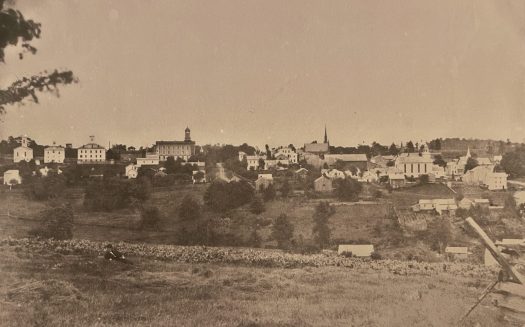
Despite its new location, the old courthouse was eventually torn down in 1888 to make way for a new school building. There was an interesting article published in the Montrose Democrat newspaper at the time that paid homage to the building with some rather grandiose language, noting the great history of judges and lawyers that worked there. The long article captures a sense of respect for the place, but I’m still left wondering, Why can’t I find more photographs?
Here’s another surprise, though. We still have some pieces of the old courthouse. The SCHS has a Corithian style capital that sat at the top of the pillars of the original courthouse. These were carved by Israel Birchard and his sons, and evidently, after the pillars were removed from the courthouse, they found a new home on the porch of Albert Miller’s house at the top of the west side of Public Avenue (where the county offices building is now located). Right now I am unsure what exactly happened to Miller’s house, whether it was burned in one of the great fires along Public Avenue or whether it was razed for new construction by the county. It’s likely that this Corinthian capital may be the only remaining piece left from the façade of the original courthouse.
This should have been the end of the story: unfortunately, we only have a few images and a single small tangible piece left from the county’s first courthouse. Except something incredible happened. While posting on Facebook a few weeks ago, someone suggested that the cupola from the first courthouse still exists. Really? Could it be true? It’s hard to put my surprise into words, especially when I’ve spent so much time sifting through papers and articles and pictures. I must have looked through the same folder on the courthouse at least a half dozen or more times. And yet, I believe it’s true.
So at some point, most likely during the razing of the courthouse in 1888, the cupola was moved to the property of William H. Jessup on the east side of the Montrose Green. At the time, Jessup had a law office, a low long building with a gable end, that was then located where the firehouse has its driveway now. On each side of the office, the Jessup family owned houses, one of which now serves as the United Fire Department’s home. Since Jessup served as both a lawyer and a judge in Susquehanna County, it’s not surprising that he may have acquired the cupola from the courthouse, which I believe is beside the current house on the next property up from the fire department’s driveway (almost directly across from the gazebo). And what a surprise, since this major piece of the first courthouse has been right here this whole time!
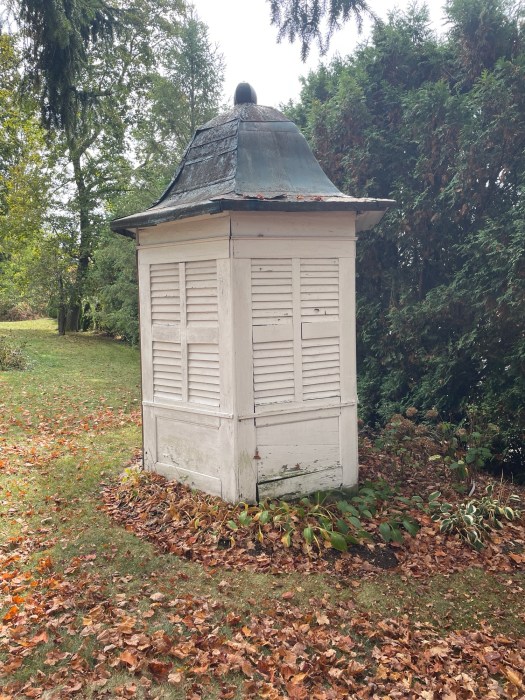
After visiting the cupola, with permission from the owner, of course, I learned a few more details. For instance, the cupola is six-sided, the original having shutters on each side that were most likely painted green as seen in the paintings. This detail escaped me until seeing it first-hand, as I thought it was an octagon shape. Another interesting fact is that the building was used as a smokehouse at some point, perhaps by the Jessups, and looking inside today, we can still see the charred and sooty wood. A door has been added, too, most likely in its conversion to a smokehouse. Indeed, I believe this artifact, despite the many years, seems to be in remarkable condition, and when I make comparisons to the photograph of the original courthouse, it certainly seems real. And although I’m still searching for that holy grail photograph of the front of the courthouse, I have to admit that knowing that the cupola still exists may be even better.
 The White Whale
Very interesting……thank you for your research.
Yahoo Mail: Search, Organize, Conquer
LikeLiked by 2 people
Fabulous and interesting history. Thank you for sharing your work.
LikeLiked by 1 person
very cool
LikeLiked by 2 people
Really interesting. Thanks for all the research and for writing this up! Just to churn scholarly debate–I guess I’m not sold on the idea that the old court house was moved. What if the new courthouse was built where the gazebo was? Paintings distort perspective all the time so I’m not convinced the old court house was actually originally located where the new one is now. What if the old court house was originally placed as it is depicted in the photograph but the artist of the painting moved it a little bit so the viewer could see it better? I mean it would have been a pretty bad painting without something up there to focus the eye. or maybe even the artist was on a upper floor window or even a roof which would bring the old courthouse into the picture plane (the horse seems pretty small and the building on the left indicates our artist wasn’t of the highest caliber regarding perspective)? I mean why move the court house..what a pain! what an expense! In other words, it seemed like your analysis was purely based on photography and the paintings–are there public records available describing the move of the courthouse? Or maps? If it wasn’t moved it would sort of make sense that the roads there are sort of chaotic as the new court house would have been plopped down in what I image was a round-about associated with the gazebo. (which would answer one question I’ve had all my life, the other being why Public Ave doesn’t line up with S. Main St)
Also, is the roof of the cupola lead?
thanks again for your work!
LikeLike
Very interesting! Have you seen the photo of Montrose that hangs in the center hall of the Batron-Myer Funeral Home on Church Street? I don’t know if you’d find it useful but it appears to be very similar to the one that hangs in the courthouse. It’s also a panorama but taken from the other side of town, perhaps from Ridge Street or thereabouts. The east side of the current courthouse is visible as well as, what I believe to be, the facades and cupolas of the 3 white buildings facing the Green.
I love reading about local history and am looking forward to your future articles!
LikeLike
I have not seen this picture. Perhaps, it is the same as the other one I have referenced many times?
LikeLike