
On a recent trip to Rochester, New York, to pick up my daughter after her first year of college, I listened to one of my favorite biographies, Henry David Thoreau: A Life by Laura Dassow Walls. I’ve heard that she could have written three books on Thoreau, but at the behest of her publisher, had to confine her story to only one volume. It’s the definitive book on Thoreau, and as I listened at random, I happened upon an interesting detail.
First, let me say, that Walden remains at the top of my list of favorite books, which surprises me, because I’ve often thought of fiction as the literary pinnacle. Over the past twenty years, however, I always look forward to teaching Thoreau to my juniors, and I even took a creative writing class on a field trip to Concord and Walden, one of the highlights of my career. I’ve done a lot of writing about Thoreau here, obviously, but I’m always struck by something new.
One of the things I teach when approaching Walden with my students is Thoreau’s fascination with deeper understanding. As a quick study, Thoreau builds many metaphors into his book, and if we consider even that very famous paragraph where he says, “I went to the woods because I wished to live deliberately…,” we can see his language, often with metaphor, trying to capture deepness. He wants “to live deep and suck out all the marrow … to cut a broad swath a shave close.” Indeed, this language becomes one of the hallmarks of Walden.
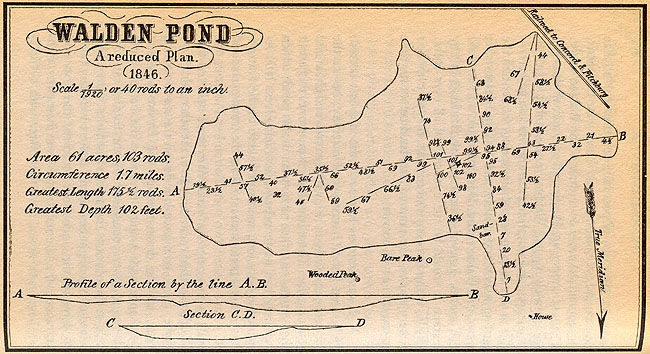
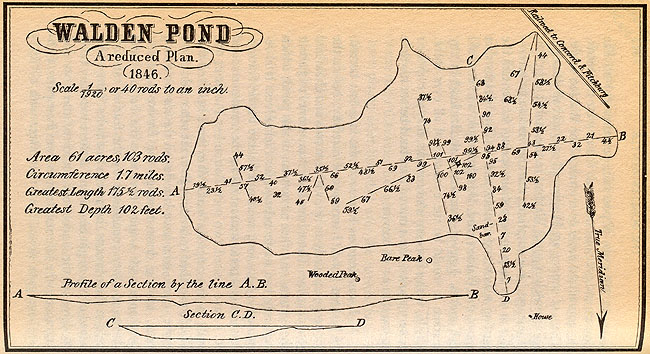
In her biography, though, Laura Dassow Walls points out that Thoreau had also found the very real embodiment of deepness by making his house at Walden Pond. At the time, it was rumored that Walden was bottomless, and Thoreau, noting this suggestion in the book, sets out to survey the pond. This was no easy task, according to Walls, for Thoreau, who worked as a surveyor, measured the pond’s perimeter of 2,900 feet using increments of 66 feet. To measure the pond’s depth, he cut over one hundred holes in the ice, having set himself to the task in January 1846, where he dropped a line weighted with a heavy stone to take regular readings. By the end, he determined the pond to be 102 feet deep, making it the deepest freshwater pond in Massachusetts. Let me repeat: Walden is the deepest pond in Massachusetts!
Thoreau would make this the most storied pond, too. It’s remarkable, really, that he should find himself on the shore of not just any pond, but one that could become the very symbol of his natural and sociological investigations. Such serendipity often leaves us shaking our heads. Might this be the defining feature that inspired Thoreau’s language? Had he found only a shallow stream to contemplate, might his thoughts, too, skipped only across the surface? Fortunately, Thoreau happened to find himself at the right place at the right time—a place not only deep, but deep enough to match his soul.


That was interesting. I can’t imagine measuring the lake’s depth during a cold winter in those days but it made sense to do it that way, as opposed to sitting in a boat and trying to anchor yourself at each reading. Thoreau was a very patient man to say the least.
Later, Bill
>
LikeLike