
First, let me say, it’s strange how I came to the Little House on the Prairie books by Laura Ingalls Wilder, often considered for children or young adults. The books never appeared on any of my must read lists. Instead, in an effort to downsize her house, my girlfriend had given me a complete set of Little House books for my classroom library, and as I began to contemplate my summer reading, I found myself looking over them. I’ll just read one, I thought. Soon I was hooked. Of course, I was already familiar with the story from the television series, which I remembered watching as a child. I must have seen the show in syndication, because I was only 8 years old when the show’s final episode aired after nine seasons in 1983. As usual, the screen adaptations proved very different from the books.
There’s much controversy around Wilder’s portrayal of Native Americans in her third book, Little House on the Prairie, which serves as the namesake of the series. I cringed at times while reading. However, there are some redeeming qualities, at least to me, like when Laura’s father tells her that the white people will have the best pick of the land. Laura asserts, “But, Pa, I thought this was Indian Territory. Won’t it make the Indians mad to have to—.” Her father cuts her off at this point and sends her to bed. It’s such an interesting interchange, because her realization is indeed correct, and moreover, suggests a more sympathetic understanding of Native Americans. Indeed, this suggests a humbler attitude toward the natives than the “adult” perspectives offered by her father and even worse perspective of their neighbor, Mrs. Scott, who repeats, “The only good Indian is a dead Indian.” It’s complicated, no doubt, reading these books in a modern context.
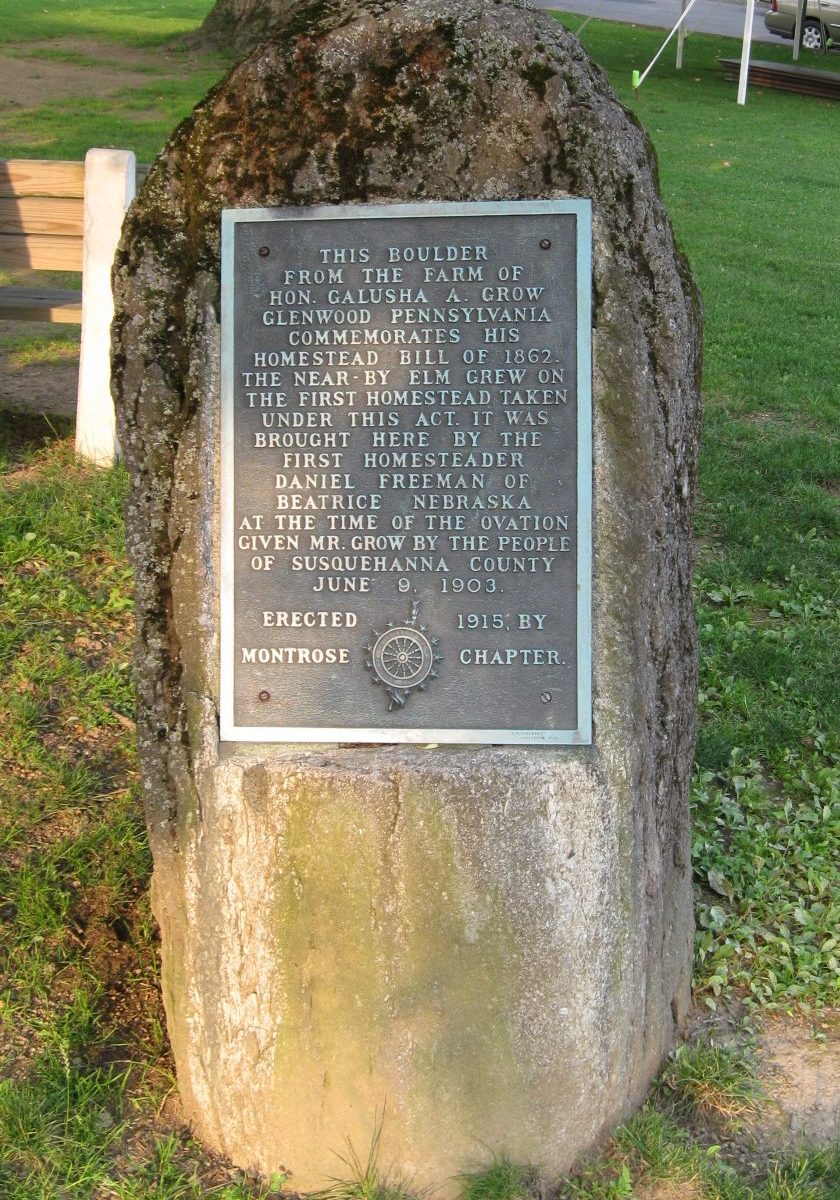
At the time of my reading, I had been researching our town’s original courthouse at the local historical society when I happened upon a big rock. Literally, I found a picture of a big rock that sits on our public space known as The Green in Montrose, Pennsylvania. Of course, I had seen this rock many times over the years, but never realized this to be a monument related to the Homestead Act of 1862.

It reads: “This boulder from the farm of Galusha A. Grow, Glenwood, Pennsylvania, commemorates his Homestead Bill of 1862. The near-by elm grew on the first homestead taken under this act. It was brought here by the first homesteader, Daniel Freeman of Beatrice, Nebraska, at the time of the ovation given to Mr. Grow by the people of Susquehanna County, June 9, 1903.”
Obviously, this boulder has backstory. In my research, I learned that when Grow won election to the House of Representatives in 1851, he was only 26, the youngest member of Congress. He represented Susquehanna County well as Bradford and Tioga. Eventually, he became Speaker of the House at the outbreak of the Civil War, an honor that suggests his immense respect among his peers. It was during his first year in Congress, however, that Grow gave a notable speech in favor of the Homestead Bill, which would allow citizens to claim 160 acres in exchange for farming the land for five years. It didn’t pass, but he continued to bring the bill before Congress for the next ten years. His repeated efforts culminated with its passage in 1862, which he signed while serving as Speaker of the House. For these reasons, he is often referred to as “The Father of the Homestead Act,” and in addition to the boulder, Montrose named a street in his honor, Grow Avenue.
All this brings us back to Little House on the Prairie, since the Ingalls and Wilders, like so many others, moved west hoping to claim their 160 acres. It must have seemed an easy prospect, but having read all the books written by Laura Ingalls Wilder, I understand that wasn’t the case. We might also argue, rather surprisingly, that if it wasn’t for Grow’s resolute efforts to pass the Homestead Act, Laura Ingalls Wilder may not have written her Little House books at all. Indeed, her family may not have even left home if not for a representative from a relatively obscure place in Pennsylvania that we sometimes forget played a prominent role in history.

